

 Current position >About Us
Flow Meter Christmas Tree: Multi-Port Medical Oxygen Delivery Manifolds
Quick Answer: A flow meter Christmas tree is a multi-port manifold assembly that integrates dedicated flow meters onto each branch to measure and distribute oxygen from a single source to several outlets. Silver Automation Instruments supplies thermal mass and vortex flow meters preconfigured for oxygen, with 4-20 mA HART output and ATEX options.
Need a fast quotation? Send us your pressure (bar), temperature (°C), pipe size (DN), and flow range in Nm³/h or L/min.
What Is a Flow Meter Christmas Tree
In industrial gas work, a Christmas tree is not the oilfield assembly. It is a compact distribution block with multiple ports. Each port carries a shut-off valve, a check valve, and often a dedicated flow meter. Hospitals and gas filling plants use this layout to feed oxygen to many beds or filling heads from one central manifold. The name comes from the shape, a main trunk branching out into multiple lines.
Why Oxygen Delivery Needs Per-Port Flow Meters
Oxygen costs money whether it is produced on-site or purchased in cylinders. Without flow meters on each line you cannot track real consumption, detect small leaks, or bill departments correctly. Most engineers skip this detail during the first installation. But once the system grows beyond 10 oxygen points, the data turns critical. A thermal mass meter measures mass flow directly in kg/h or Nm³/h and does not need extra pressure and temperature compensation. That is a big step up from glass tube rotameters that need someone to read them every shift. Silver Instruments builds inline thermal mass flow meters with a PT100 sensor, accuracy ±1.5% of reading, and repeatability ±0.5%. The meters arrive degreased and oxygen-cleaned as a standard option.
Typical Manifold Layout and Instruments
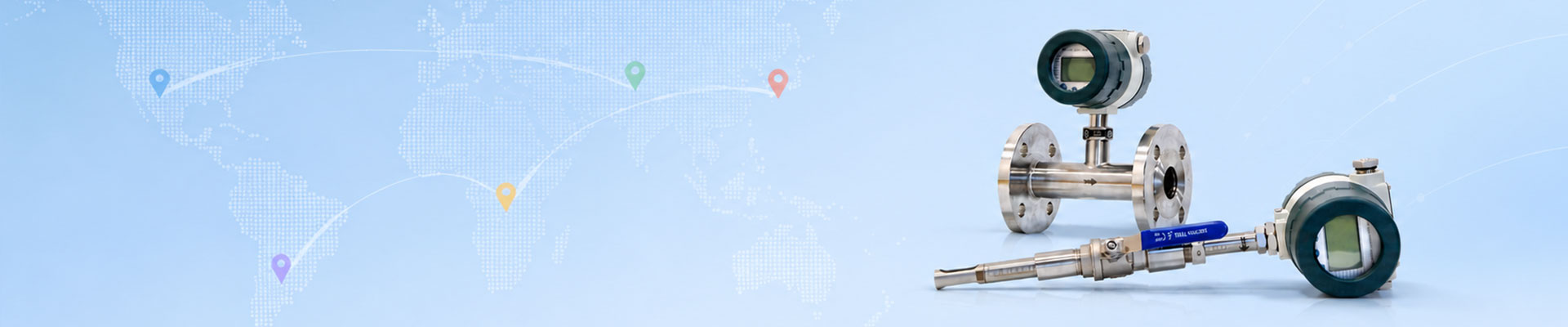
A common design puts a pressure regulator at the inlet of a 4-port to 20-port manifold block. Each branch gets a dedicated flow meter, a ball valve, and a non-return valve. Pipe sizes are often DN10 or DN15 in 316L stainless steel. For a 6-port oxygen manifold, you can install six Silver Instruments SITF600 thermal mass flow meters with a local display and 4-20 mA plus HART. The signals feed into a PLC or our paperless recorder. Because medical oxygen is dry and clean, no complex filtration is needed, but we recommend a 40-micron strainer upstream of each meter. The whole setup is straightforward for any local pipe fitter.
Thermal Mass or Vortex for Oxygen Lines
Engineers often ask which technology fits best. Here is the thing. For stable low-pressure lines up to 10 bar and velocities below 30 m/s, a thermal mass flow meter is the natural choice. It has no moving parts, very low pressure drop, and gives direct mass flow. For high-pressure oxygen systems that run up to 40 bar, or when a customer does not want a small sensor probe in the stream, a vortex flow meter with built-in PT100 compensation works better. The Silver Instruments SVY series covers DN15 to DN200, handles media temperatures from -40 °C to 250 °C, and offers Ex ia IIC T4 for Zone 1. We have seen a customer in Vietnam use a 10-port vortex setup on oxygen cylinder filling racks. They reduced pressure to 10 bar after the letdown station and measured flow there. This avoided expensive high-pressure rated meters while still getting accurate data.
Real Installations and Field Notes
A paint manufacturer in Southeast Asia needed 12 ports to distribute oxygen to reactor tanks. They chose DN15 thermal mass flow meters from Silver Instruments. Each meter had a local rate and totalizer display, plus 4-20 mA sent to their DCS. The buyer shared three numbers: operating pressure 4 bar, ambient temperature 25 °C, and flow range 1 to 100 L/min per port. We configured the meters for 0-100 L/min, calibrated them for oxygen with NIST-traceable standards, and shipped within 4 weeks. An